The NYS Focus Center at Rensselaer Polytechnic Institute (RPI)'s primary mission is to research and develop materials and structures for the next generation of interconnects in semiconductor integrated circuits. Over the past years, the NYS Focus Center has expanded its vision to become a long-term research and development resource that provides the scientific foundation for future advancements in microelectronics. Together with RPI's Center for Materials, Devices, and Integrated Systems (CMDIS), the NYS Focus Center benefits from a collaborative research environment in physical sciences and engineering. The Micro and Nanofabrication Cleanroom and the Nanoscale Characterization Core attract users and researchers from academic, governmental, and industrial partners. The NYS Focus Center is also a powerhouse in training graduate students and postdoctoral researchers, many of whom transition to semiconductor industry leadeship roles.
Strategically, the NYS Focus Center focuses on the challenges of developing next-generation interconnects to meet the industry's shrinking dimensions and increasing current densities. Its work includes researching new materials for electron and phonon transport at nanoscales, exploring low-power device concepts for energy-efficient AI applications, and innovating fabrication and metrology techniques to translate theoretical advancements into practical applications. The NYS Focus Center collaborates closely with major industry players, aiming to align its research strategies with industry needs and foster co-funded projects.
Thrust I: Advances in Interconnect Technology
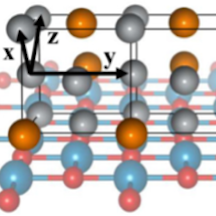
This thrust focuses on advancing fundamental understanding of electronic and thermal transport at ultra-small dimensions, enabling new materials solutions such as anisotropic conductors and topologically protected conductors. It also includes applications of optical interconnect methods to advance both local and chip-to-chip data transfer rates.
image credit: Epitaxial VNi2 layers, Daniel Gall

Thrust II: Low Energy Electronics
New device concepts to reduce power consumption in logic and memory devices, including multi-state memristor devices, electron spin devices and devices based on two-dimensional materials. Such devices will be critical to accommodating the ever-increasing power demands for widespread AI application.
image credit: Spiral resonator, Jian Shi
Thrust III: Metrology and Processing
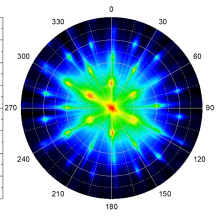
As device dimensions continue to shrink and device architectures become increasingly three-dimensional, new processing and metrology methods must be developed. A core theme is controlling thermal transport at the device and chip level, as will be development of new green chemistry approaches to meet environmental and regulatory imperatives.
image credit: Reflection High-Energy Electron Diffraction (RHEED), Gwo Ching Wang and Toh-Ming Lu
Current Projects:
Epitaxial growth of in-plane hexagonal conductors
Daniel Gall, Ethan Hendrix
Molecularly engineered inorganic interfaces for nanodevice wiring and thermal management
Ganpati Ramanath, Kyle Max
Control of orientation and handedness of nanoscale topological and directional interconnect conductors on amorphous SiO2
Ravishankar Sundararaman, Tanooj Shah
Silicon Photonic Devices for Optical Interconnect in Scalable Chiplet Applications
Rena Huang, Tianle Xu
Factors affecting the evolution of Conduction Filament in Asymmetric Metal-Insulator-Metal based Resistive Switching Devices
Robert Hull, Subhangshu Sen
Quantum phenomena in correlated magnetic materials driven by electrical field
Gwo-Ching Wang, Nymul Yeachin
MgB2 Superconducting Low Energy Electronics
Jian Shi, Zixu Wang
Manipulating superconductivity by cavity strong coupling
Wei Bao, Xiaolong Wu
Thin films and interfaces through molecular dynamics simulations
Pawel Keblinski, Anoop Kumar Kushwaha
Immersion Scanning Thermal Microscopy (SThM)
Theo Borca-Tasciuc, Jonas Kendra
Validating 2D Material Strain Mechanisms using SERS-Enhanced Spectroscopy
Joel Plawsky, Zixiu Cai
Breaking C-F bonds using hydrated electrons: A greener approach using Heterogeneous Catalysis
Vidhya Chakrapani, Shashank Rao Mangu